What My ChatGPT Export Reveals
The other day I wondered whether it was possible to export all my ChatGPT conversations.
It is.
Settings → Data controls → Export data
The export is not immediate. First I received an email saying it may take a few days. About 26 hours later, another one arrived with the download link.
I opened it with a simple question in mind:
How has my use of ChatGPT changed over time?
I keep using it more
The first pattern was not exactly shocking: the number of messages keeps going up.
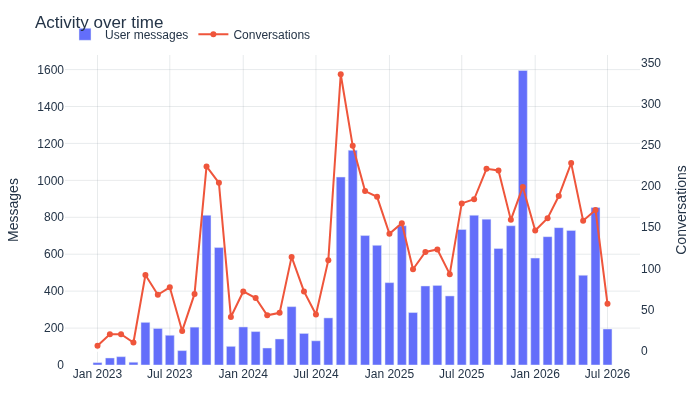
There is a clear bump in September and October 2024.
A couple of things happened around then. GPT-4o got better with uploaded files and memory, and in October OpenAI launched Canvas, which I remember using a lot. Much less now, because when I work on a document I usually do it with Codex connected to my Obsidian vault. The bump also lines up with Offbeat League. I suspect each fed the other.
My busiest days are often weekends
The GitHub-style activity calendar for the past 12 months shows something else. Since this is my private account, many of the heaviest usage days land on weekends.
Again, nothing surprising. Weekdays are for work. Weekends are where personal projects, experiments, and ideas with poor supervision get to stretch their legs.

What do I actually use ChatGPT for?
Digging a bit deeper, I classified my messages into eight broad categories:
- Ideation and product design
- Writing and language
- Creation and generation
- Decision and comparison
- Programming and debugging
- Learning and explanation
- Research and verification
- Planning and logistics
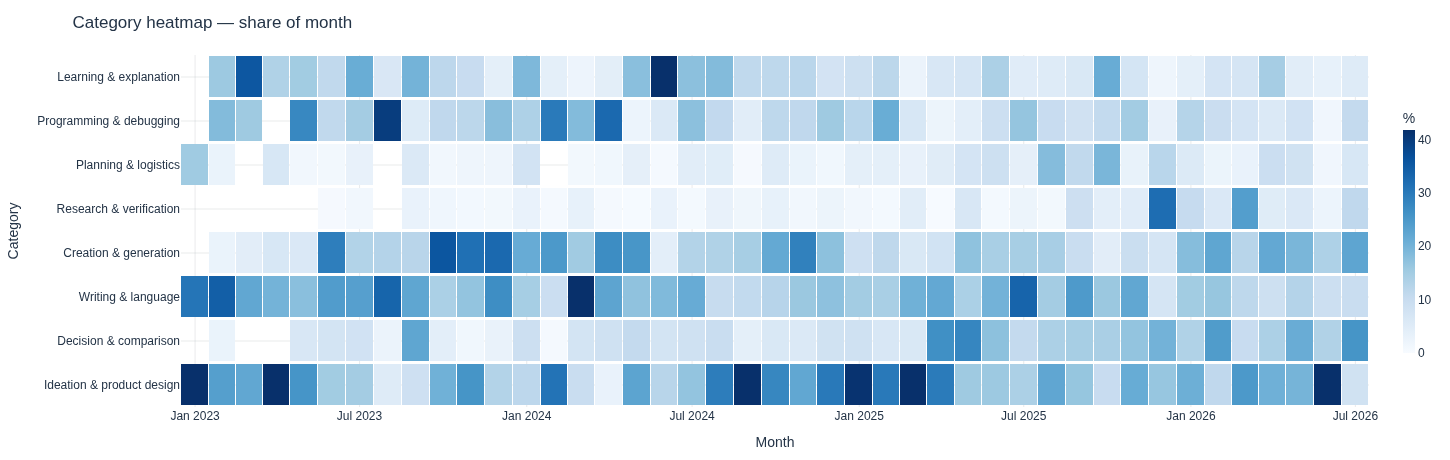
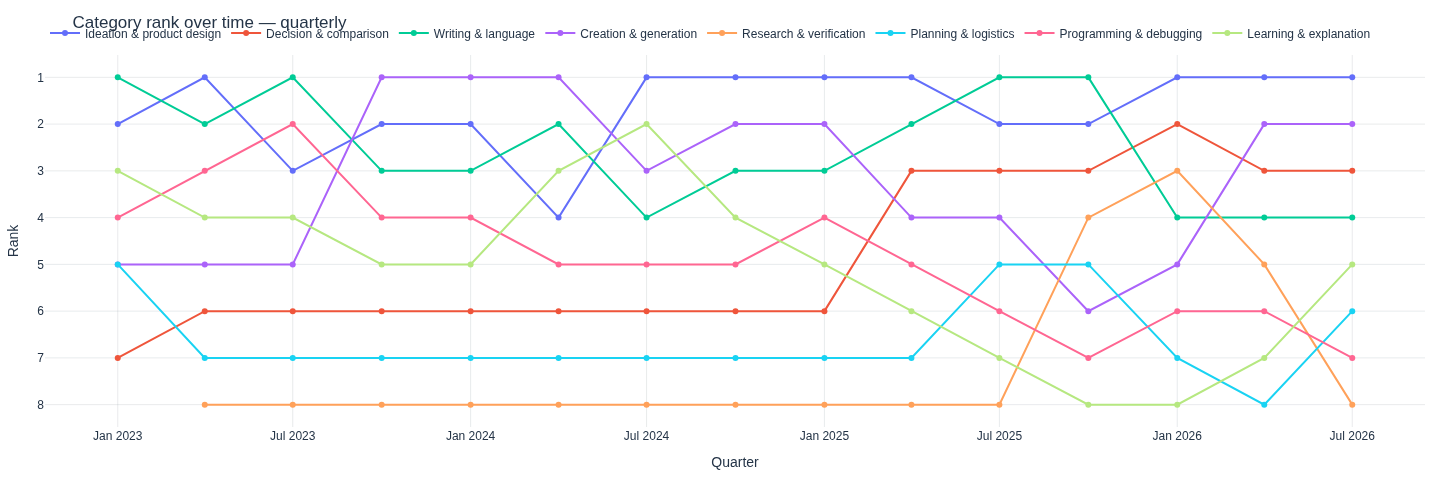
Below are a couple of visualizations of the messages seen through these categories.
Ideation has been the constant
Ideation and product design stays strong through the whole period.
This is probably the clearest description of how I use ChatGPT: as a creative partner.
I use it to explore business ideas, test project concepts, find weak points in an argument, brainstorm names, sketch product structures, and turn vague thoughts into something I can actually inspect.
A lot of the time I am not asking for an answer. I am using the conversation to figure out what the question is.
Writing and language reflects where I live
Writing and language is another consistently important category.
I live and work in Italy, mostly in Italian, and I am still not fully fluent. So I use ChatGPT to correct messages, improve phrasing, understand expressions, and check whether something sounds natural.
It has more or less replaced Google Translate and WordReference for me.
Creation somewhat triggered by capability jumps
Creation and generation has one jump that seems correlated with a model release. In October 2023, DALL·E 3 had just been added to ChatGPT, and my Creation activity jumped from 25 messages in September to 290 in October. Finally I could generate all those avocado chairs directly in ChatGPT.
Programming moved elsewhere
Programming and debugging was strong early on, then declined.
At first, ChatGPT partly replaced Stack Overflow for me. Instead of digging through several vaguely related answers, I could describe the exact error, include the surrounding code, and ask follow-up questions.
Later, some of that work moved to GitHub Copilot and now almost entirely to Claude Code and Codex.
ChatGPT still matters at the start of the process. A conversation may begin with an idea and turn into:
- a small Python script;
- a database structure;
- an interactive HTML prototype;
- or a rough technical architecture.
But after a couple of iterations, I usually move the prototype into VS Code with Claude Code and Codex extensions.
The unexpected result: I use it less for “learning”
The most surprising pattern was Learning and explanation.
In the first half of the period, it usually sat in the upper half of the categories. Later it dropped into the bottom half, and for several quarters it was close to last place.
If someone had described ChatGPT to me five years ago, I probably would have said, as an autodidact:
“That sounds perfect for learning things.”
And it is. Just not in the classic sit-down-and-study sense.
I rarely use it as a course, tutor, or textbook replacement. Learning is usually embedded in something else, usually a project.
There is some potential here though. In the language case, for example, I can imagine a more proactive assistant that automatically adds words, phrases, and grammar structures I keep tripping over to an Anki deck. Or one that uses memory more efficiently for the occasional virtual ruler slap: “Hey. Third time this week with this grammar structure. Sort yourself out.”
From answer machine to thinking environment
I use ChatGPT more, but I also use it differently. It moved from being an answer machine to something closer to a thinking environment.
The change was not just capability. It was the range of things that started feeling worth bringing to it. Less “tell me the answer,” more “help me poke at this until it becomes something.”